Friday, March 2, 2012

Welcome 2012: "Zigzags, Stripes, and Shadows" by Julie Alpert

"Stream of consciousness drawings become blueprints for how I respond to the Telephone Room's cramped, charming, and curious architecture. Utilizing the shelves, telephone alcove, cabinet doors, and window, painted lines follow and cascade off the various surfaces transforming the once useful room into a mysterious three-dimensional painting. Cardboard figures cast ominous shadows while woodgrain contact paper is collaged to mimic the old hardwood floor. While preparation and gathering of materials happen offsite, final decisions for how to arrange and address the space are improvised, dependent on my intuition for composition and color relationships."
---Julie Alpert, February 2012.

Julie Alpert, Telephone blueprint 1, 2012, collage, 5.5" x 8.5".
Photo courtesy of Julie Alpert.

Julie Alpert, Telephone blueprint 2, 2012, collage, 5.5" x 8.5".
Photo courtesy of Julie Alpert.

Julie Alpert, Telephone blueprint 3, 2012, collage, 5.5" x 8.5".
Photo courtesy of Julie Alpert.

The Telephone Room Coloring Book Project:
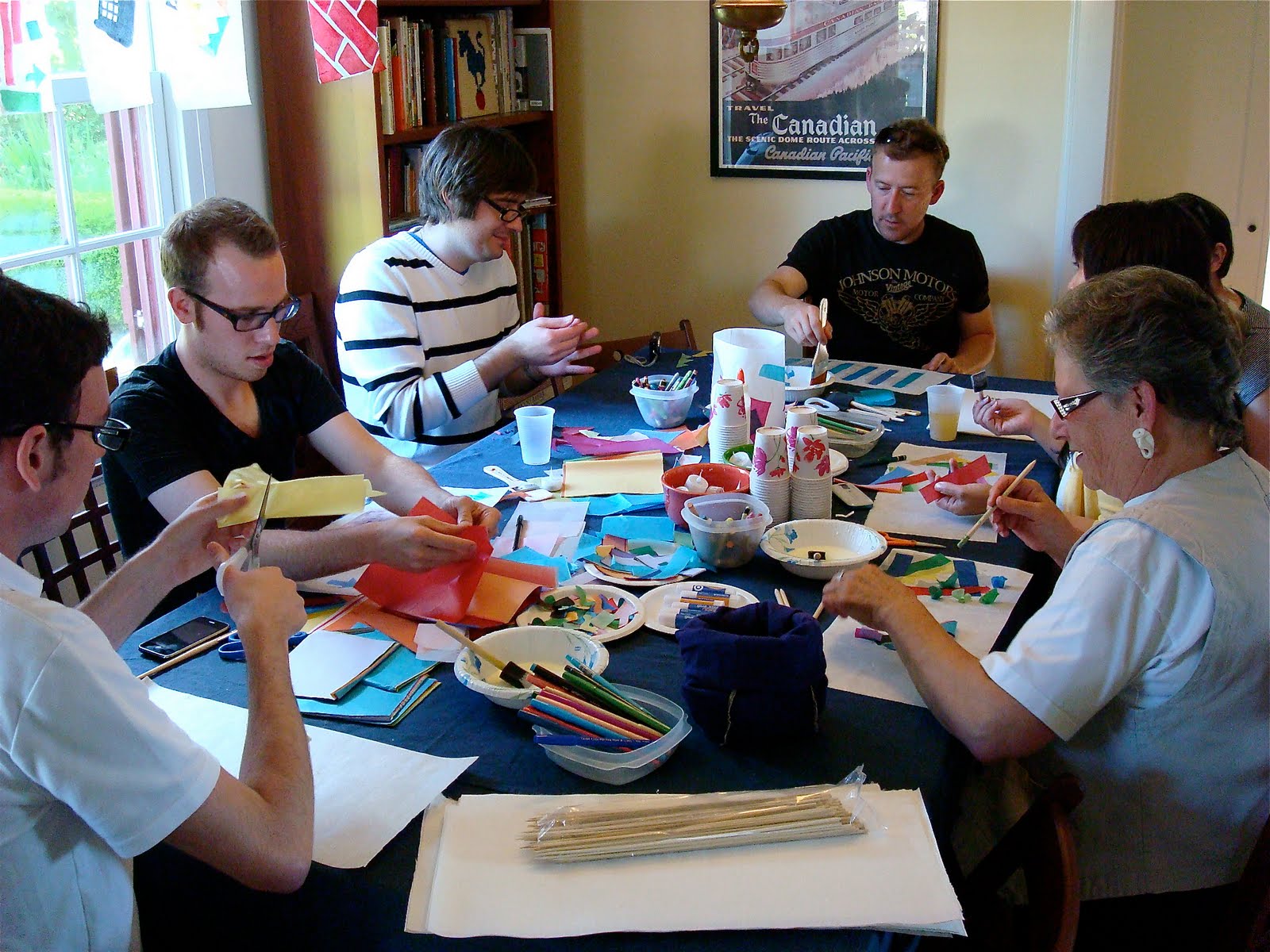
As a way to gain insight into Julie's process, a stack of blank "blueprint" sketches of the Telephone Room will be provided alongside collage materials. Visitors are encouraged to customize a blueprint, much like the empty pages in a coloring book, according to their own intuition, aesthetic and imagination. Drawings will remain at the gallery through the duration of the show.
Julie Alpert, Telephone blueprint, 2012, ink drawing, 5.5" x 8.5".
Photo courtesy of Julie Alpert.

Julie Alpert is an artist living in Seattle, SOIL member and Gage Academy instructor who was awarded a 2012 Pollock-Krasner Grant. Her artwork has most recently been seen at the ONN:OF Festival, SOIL gallery, UW Jacob Lawrence Gallery, NEPO House and much more. Julie will be creating a site-specific work within the Telephone Room Gallery.

See and read more at: www.juliealpert.com and www.juliealpert.blogspot.com.

Zigzags, Stripes, and Shadows by Julie Alpert is on view at the Telephone Room Gallery from March 3 - April 30, 2012. Viewable by appointment almost anytime -- email us at thetelephoneroom@gmail.com for an appointment.

Tuesday, September 13, 2011

"Out of the Embers" by Allison Hyde

Using experimental printmaking, mixed media and sculpture, Allison Hyde's work seeks to explore ephemeral moments, and our notion of emotional loss associated with personal pasts. By splitting video sequences into still photos and recreating the images via printmaking she examines the subtleties of fleeting moments and the nostalgia related to recollections of memories. As muffled voices emanate from the charred confines of small boxes in Out of the Embers, the viewer is allowed a private moment to hear lists of other people's most important possessions -- allowing reflection upon the potential significance and emotional triggering effects that objects have in our lives.
Allison Hyde, "Out of the Embers," installation detail at the Telephone Room Gallery, 2011.
Allison Hyde grew up in Lakewood, attended Charles Wright Academy and Colorado State University, and recently completed her MFA in Printmaking at the University of Oregon.
See also http://allisonhyde.tumblr.com/.

Out of the Embers by Allison Hyde is on view at the Telephone Room Gallery from September 10-30, 2011. Viewable by appointment almost anytime -- email us at thetelephoneroom@gmail.com for an appointment.

Tuesday, May 31, 2011

What Was Your Favorite Craft?

That's what we asked some artists as we get ready for the opening of Assignment: Crafty on June 4.

Elise Richman:
   "I loved making candles as a kid. The process involved amazing transformations and vats of heated wax seemed like witches' cauldrons. Candle crafts feel very elemental. I was rapt watching candle wax melt like ice bergs into pools of lava. Candles are shape-shifters of a sort becoming layered rainbow stars, solid scented blocks, dipped tapered stalks or just about anything.
   I could never master any crafts involving yarn and hooks. I always blamed my left-handedness but know this is a poor excuse since I'm certain many south paws are knitting/crocheting fiends. My fingers get twisted and I can't manage the delicate intricacies of casting on, stitching and knotting. This was a source of shame when knitting became hipper than cupcakes or being in a band."
http://www.eliserichman.com/

Graham Bell:
   "My favorite was always drawing "boycentric" drawings. Of cars and dinosaurs and robots.
   My trouble was when it was realized by my teacher that I was just tracing out of a book with exceptionally thin paper and then adding on my own touches. Usually having to do with dino-robot-cars. Zoom. Rawr. Beep.
   Also I really liked gluing construction paper to itself with a gluestick. Never Elmer's. The slow-drying time was a definite negative."

Lisa Kinoshita:
   "As a kid I made daisy chains, also chains folded from Doublemint gum wrappers. Early inklings of jewelry making..."
http://www.lisakinoshita.com/

Shannon Eakins:
   "That's a hard question for me, but I had a special love of that clay that you made from flour, salt, and water (an early self-drying clay?). I remember making figurines, and miniature girl-scout cookies with it. The best part was using my mom's clear nail polish (shhhh!) to seal my creations, always before they were completely dry, and then watching the mold grow."
http://www.shannoneakins.blogspot.com/

Jennifer Adams:
   "When I was a kid, I enjoyed cross-stitch. Before heading to a friend's mountain cabin for two summertime weeks, we would head to the sewing store. My mom allowed my sister and me to pick up a little cross-stitch kit to pass the time when we weren't hiking, reading, playing UNO or saving mountain dogs.
   Now I enjoy knitting, which I am terrible at, and needle felting, which sometimes scares me because the needle is so big and barbed, and moving in such a fast stabbing motion!
   I have always wanted to whittle little animals out of wood, but am afraid of cutting myself to ribbons. As a kid, I tried with soap. I ended up with a chunk of chopped up soap and a mad dad."

Colleen Maloney:
   "My favorite craft is also a favorite family memory. When we were kids we got to decorate our own Christmas tree. So we sit on the floor and make our own ornaments out of straws, pipe cleaners, glitter, egg cartons and whatever else we could find. The only challenge was cleaning up the Elmer's glue and glitter on the coffee table."

Marc Dombrosky:
   "At the time, it felt more like an intensive training mission than a *craft*, but my brother and I would build extensive arsenals out of white paper and Scotch tape that we would then emblazon with insignias--Thundercats, Ho!--code numbers, buttons, and secret messages meticulously drawn in black marker. Telescoping swords would have components that would augment their use, like robotic gloves, secret compartments full of paper throwing stars and a shoulder strap. A shoulder strap?"
http://www.marcdombrosky.blogspot.com/

Revisiting craft projects culled from how-to books from the 1960s to the 1980s, Assignment: Crafty asked artists to explore three randomly assigned projects taken from these books. Artists were given the freedom to create one, two or all three projects, and encouraged to modify, combine and interpret the projects in any way through the filter of their own artistic practice.

Come see contemporary perspectives on fish printing, bottle gardens, rock creatures, Ojos de Dios and more from the following artists: Jennifer Adams, Jessica Bender, Peter Lynch, Matt Johnson, Ann Darling, Lauren Faulkner, Chris Sharp, Colleen Maloney, Elise Richman, Saya Moriyasu, Tobin Eckholt, Maria Jost, Meghan Mitchell, Lisa Kinoshita, Jennifer Peters, and Terry Dew.
 
Assignment: Crafty is curated by Ellen Ito and is on view at the Telephone Room Gallery from June 4-30, 2011. The opening is on June 4 from 5-9 p.m. Viewable by appointment almost anytime afterwards -- email us at thetelephoneroom@gmail.com for an appointment.

Thursday, May 26, 2011

Rock Craft by Saya Moriyasu

Revisiting craft projects culled from how-to books from the 1960s to the 1980s, Assignment: Crafty asked artists to explore three randomly assigned projects taken from these books. Artists were given the freedom to create one, two or all three projects, and encouraged to modify, combine and interpret the projects in any way through the filter of their own artistic practice, as well as document their efforts.

The following craft was executed by Saya Moriyasu.

Assignment: Crafty is curated by Ellen Ito and is on view at the Telephone Room Gallery from June 4-30, 2011. The opening is on June 4 from 5-9 p.m. Viewable by appointment almost anytime afterwards -- email us at thetelephoneroom@gmail.com for an appointment. 

Monday, April 11, 2011

"Dead Loss" by Jessica Bender

Coming on April 15, 2001: Dead Loss... an installation inspired by solitary confinement, padded cells, and blanket forts by Jessica Bender during the months of April and May, with an opening on Friday, April 15 from 6-9 pm.

Jessica is a midwest transplant to the northwest, and her art is about identity. She wants to be a vampire.

Jessica Bender, Dead Loss, installation detail at the Telephone Room Gallery, 2011.
In the meantime, browse around Jessica's blogs: http://www.cabinet713.blogspot.com/ and http://www.jessicaabender.blogspot.com/, and see more images of her work at https://picasaweb.google.com/jessica.bender.

Jessica's work has previously been seen in the Hello! and Undead group shows at the Telephone Room Gallery, as well as in a solo installation The Bluebird, inspired by Charles Bukowski and his poem My Telephone. Her art was most recently seen in Tacoma as part of the SpaceWorks Tacoma project: http://www.wait-whereami.com/ and http://spaceworkstacoma.wordpress.com/2010/09/16/.

Jessica Bender, Prey, Mixed media, 11½(w) x 9½(h) x 4(d) inches, 2009.
Jessica Bender, The Bluebird installation at the Telephone Room Gallery, 2009.
"The Bluebird is an installation inspired by and celebrating the life and work of Charles Bukowski, American poet and author, for his birthday August 16th." --Jessica Bender
Jessica Bender, The Bluebird installation at the Telephone Room Gallery, 2009.
Jessica Bender, The Bluebird installation detail at the Telephone Room Gallery, 2009.
Jessica Bender, to baby strigoli, with love, felt, leather, found buttons, ring boxes, whiskey, "blood," 2009. For sale: $66.6
Dead Loss by Jessica Bender is on view at the Telephone Room Gallery from April 15 - May 28, 2011. Viewable by appointment almost anytime -- email us at thetelephoneroom@gmail.com for an appointment.

Wednesday, March 30, 2011

Exit133 Tacoma Arts in Review: "Emulate" at the TRG

Erin Bailey visited us for our Party Line with Lauren Faulkner on March 18, and gave us a nice write-up on Exit133 this week:
http://www.exit133.com/6199/

---------------------------------------------------------------------------------
Tacoma Arts in Review: "Emulate" at the Telephone Room Gallery
(March 27, 2011 by Exit133 Tacoma Arts in Review)
by Erin Bailey
 
The Telephone Room Gallery is an alternative art space located in the North Tacoma home of Heide Fernandez-Llamazares. This pint-sized gallery operates under the mission “to house artist-driven exhibits and programming. Big ideas in an intimate space.” Named for the working rotary telephone mounted inside, the Telephone Room offers uniquely personal opportunities to experience art up close and to interact with artists over a welcoming kitchen table.

Emulate: A Visual Interpretation of Schiele’s Nudes features three nude portraits by emerging artist Lauren Walker inspired by iconic artist Egon Schiele. Faulkner’s work takes the viewer along on an artistic journey as Faulkner captures Schiele’s style while displaying her own progression and inspiration, and challenging her abilities. Egon Schiele was an Austrian artist during the turn of the 20th century who studied under Gustav Klimt, drawing inspiration from artists such as Edvard Munch and Vincent van Gogh. Early in his career Schiele gained fame for his pornographic style, depicting women in erotic positions. Schiele defended the legality of distributing his work in public against many who argued it was pornography which resulted in the destruction of his work and three days in prison.

This is Faulkner’s first showing in a gallery since she graduated from University of Puget Sound with a concentration in painting, and her commitment to learning from process and exploration is clear. Says Faulkner: “In this series, I examine Schiele in terms of style. I combine some of Schiele’s most revered nudes with my own palette imbuing in the paintings a synthesis of Schiele’s and my own vision of the body. By emulating his style, I hope to gain further insight into his creative process, and to create work that reflects his artistic mastery.” While her work is as stylistically her own, traces of Schiele are evident in the exposure of the human body and poses that emulate loss, discovery and sexuality. In confronting eroticism, sexuality and Schiele, Faulkner sidesteps Schiele’s trademark eroticism, and instead imbues her subjects with serenity and modesty. In explicitly addressing and exploring female sexuality, the artist acknowledges her connection with the women she depicts.

The first nude you encounter is a woman praying with her back to the world. In hiding her face and layering blues and purples Faulkner imbues the work with a sorrowful ambiance; yet despite the sadness portrayed, the subject does not appear defeated. Faulkner uses her affinity for Schiele’s style to utilize color as an emotional language, layering shades to create an aesthetic rendering of what many see as Schiele’s grotesque style in a modern and feminine interpretation. Faulkner stated that she excluded the face to leave interpretation open, to allow for an individual emotional reaction from each viewer. The exclusion of the subjects’ face and their cultural ambiguity allow for the viewer to relate easily.

The Telephone Room activates the local art community, offering both established and emerging artists a venue to share their work and interact through “Party Line” artist talks and activities. Opening homes for the arts sustains the community in times when art support suffers from budget cuts and dwindling interest. Imagine if we all were art activists, offering our homes to local artist…what would the art community in Tacoma look like? Emulate: A Visual Interpretation of Schiele’s Nudes is on view through March 28, stop in before it closes!

Thursday, March 17, 2011

"Emulate: A Visual Interpretation of Schiele’s Nudes" by Lauren Faulkner

"Born in 1890 in Austria, Egon Schiele was a figurative painter mentored by Gustave Klimt and associated with Art Nouveau and early Expressionist movements. Schiele is well known for his brutal confrontation of death, sex, loss and discovery as subject matter. His ability to convey weighty emotion through the simplicity of pose is masterful. During his life, Schiele’s work was lauded as depraved, pornographic and controversial. His visceral and uncomfortable representations of the human form, as well as the human condition, are unflinchingly honest, poignantly beautiful and expertly crafted. Although Schiele died in 1918 at the age of 28, his work reflects the talent of a fully-matured artist.

In this series, I examine Schiele in terms of style. I combine some of Schiele’s most revered nudes with my own palette imbuing in the paintings a synthesis of Schiele’s and my own vision of the body. By emulating his style I hope to gain further insight into his creative process, and to create work that reflects his artistic mastery."
---Lauren Faulkner, March 2011.

Lauren Faulkner recently graduated from the University of Puget Sound with a concentration in painting. She is originally from Portland, but Tacoma is her home for now. http://www.laurenfaulkner.weebly.com/

Lauren Faulkner, Emulate: A Visual Interpretation of Schiele’s Nudes installation at the Telphone Room Gallery, Oil on canvas paintings, March 2011. Painting on left: 22"x26"; Painting on right: 24"x30".

Lauren Faulkner, Emulate: A Visual Interpretation of Schiele’s Nudes installation at the Telphone Room Gallery, Oil on canvas paintings, March 2011. Painting on left: 22"x26".

Lauren Faulkner, Emulate: A Visual Interpretation of Schiele’s Nudes installation at the Telphone Room Gallery, Oil on canvas paintings, March 2011. Painting on left: 22"x26"; Painting on right: 24"x30".

Lauren Faulkner, Emulate: A Visual Interpretation of Schiele’s Nudes installation at the Telphone Room Gallery, Oil on canvas paintings, March 2011. Painting on left: 24"x30"; Painting on right: 16"x30".

Lauren Faulkner, Emulate: A Visual Interpretation of Schiele’s Nudes installation at the Telphone Room Gallery, Oil on canvas paintings, March 2011. Painting on right: 16"x30".
Emulate: A Visual Interpretation of Schiele’s Nudes by Lauren Faulkner is on view at the Telephone Room Gallery from March 4 - 28, 2011. Viewable by appointment almost anytime -- email us at thetelephoneroom@gmail.com for an appointment.

Friday, November 5, 2010

Perfectly Small, Perfect Fit: "Montana (erased)" by Buddy Bunting

The Weekly Volcano recommends Montana (erased) by Buddy Bunting:
http://www.weeklyvolcano.com/events/werecommend/2010/11/buddy-bunting-montana-erased-the-telephone-room-gallery-tacoma/

---------------------------------------------------------------------------------
by the Volcano Staff on November 3rd, 2010
http://www.weeklyvolcano.com/

When the Telephone Room in North Tacoma says it's the world's second smallest art gallery, it's not lying. The space is small ... perfectly small, clocking in at an economical 12 and a half square feet. The cozy confines of the Telephone Room Gallery should be the perfect fit for Buddy Bunting's Montana (erased), which will open there Friday with an all-are-welcome open house. Inspired by a random answering machine message, Montana (erased) features paintings and found objects that explore the western landscape.

Tuesday, November 2, 2010

Nostalgic Road-Trip: "Montana (erased)" by Buddy Bunting

Rosemary Ponnekanti reviews Montana (erased) by Buddy Bunting in the Tacoma News Tribune:
http://blog.thenewstribune.com/arts/2010/11/02/buddy-bunting%e2%80%99s-nostalgic-road-trip-art-at-the-telephone-room/

---------------------------------------------------------------------------------
Buddy Bunting’s nostalgic road-trip art at the Telephone Room
By Rosemary Ponnekanti on November 2, 2010
Tacoma News Tribune

Most of us, on receiving a wrong-number telephone message, would erase it and forget it. Seattle artist Buddy Bunting turned it into art, and the obvious place for it was Tacoma’s tiny Telephone Room Gallery. Opening this Friday at the Telephone Room, a closet-sized gallery in a private North End house, is Bunting’s “Montana (erased),” an installation of paintings, photographs and objects that combines nostalgia and sociology with the erroneous voicemail at its center.

Pick up Bunting’s own handset inside the room, and you can hear the message, left on his phone while he was on a Montana road trip. (Bunting tried to reroute the message through the Telephone Room’s own rotary-dial phone, unsuccessfully. That would have been cool.) The message, ironically, details another Montana camping trip, this one by an unknown woman who’s remembering a long-ago time where she and her travel partner felt insecure as the only hippies in town, not to mention the only African-Americans. It’s a dreamy message, more vision than communication and filled with both memory and a sharp sense of not belonging.

Bunting explores both these components in his surrounding installation, which fits the tiny room like a glove. Exquisitely jewel-like oils and watercolors – the wistful, washed-out style that got him entry into TAM’s last Biennial – describe mountains, grass, four-square country buildings in the middle of nowhere. A gas station, lit up against an endless black night, is otherworldly; a pale brown RV floats like a thought. Stacked on shelves are rock collections, piles of old National Geographics, dried poppy stems. Only the baby pictures don’t really work – this is about Montana as a state of mind, not a personal scrapbook. It transforms the Room into a memory, with vaguely regretful feel, of both a place and a sense that whoever lives here is on the very edge of community.

Buddy Bunting’s “Montana (erased)” opens 6-9 p.m. Friday at the Telephone Room Gallery, 3710 N. 7th St., Tacoma, and is on view by appointment through Nov. 30.
http://www.buddybunting.com/

Inspired Art: "Montana (erased)" by Buddy Bunting

Dawn Quinn reviews Montana (erased) by Buddy Bunting in the current Tacoma Weekly: http://www.tacomaweekly.com/citylife/art/inspired_art/

---------------------------------------------------------------------------------
Inspired Art by Dawn Quinn
Published on Wed, October 27, 2010
http://www.tacomaweekly.com/

Buddy Bunting depicts ‘Montana (erased)’ at the Telephone Room.

Seattle artist Buddy Bunting takes a lot of road trips. In traveling the country, he returns home inspired to work on pieces that encapsulate what he has seen. The Telephone Room Gallery’s newest show, “Montana (erased),” highlights pieces and items he has made and found on a trip to the “Treasure State.”

One element of the exhibit that ties in with the Telephone Room Gallery is a voicemail that Bunting had received while he was away that prompted and inspired the works. According to the gallery’s press release on the show, “an erroneously left answering machine message detailing a stranger’s travels through Montana form the basis for Buddy Bunting’s ‘Montana (erased)’ – continuing the artist’s exploration of the western landscape, its mythology of transcendence, openness and expansion.”

The message was a coincidence, and Bunting kept it on his phone for quite some time. Fellow Washington artist Nicholas Nyland told Bunting about the Telephone Room Gallery and he deemed it the perfect place for his newest show. In the message, the woman relays a past trip during the 1960s in which she and her boyfriend visited and were not met with the warmest reception, which led to them driving through the state and not staying.

On the left wall of the space, eight oil-based pieces don the walls on paper, cardboard and other materials. A bird, train, rocks piled high in the middle of an idyllic valley, sunrise over the horizon, a vintage van, a lone, tall, aging building in the middle of nowhere, trees and a double payphone at night, as seen at a gas station all combine to form images that Bunting likely came across often in his travels, and that together form a personal story.

Straight ahead into the gallery, shelves house more pieces, found and formed by Bunting. A detailed rocky canyon and an ink and pencil depiction of a motor home with “Creation or Bust” and “Honk 4 Jesus” donning the sides frame a hexagonal vase filled with brown flowers. Below, more prints, this time colorful, rocks likely picked up on the road, a landscape photo filled with trees, Book of Mormon and Jehovah’s Witness pamphlets, a National Geographic issue from July 1971 and a phone armed with the infamous voice message fill up the rest of the shelves.

To the right, 10 pieces fill up the expanse of the sea foam green wall. An oil colored piece of canyons tops the left side, with simple color for the sky and brown landscape. Below, five pieces of paper that look as if torn from a Moleskine notebook are all placed in succession after the other with each utilizing only one color and each highlight a store sign or a car seen along the road.

The middle and right side of the wall feature three acrylic paintings, each varying greatly in content. The first has two children’s heads and below, another scenery shot of Montana’s mountain ranges fill the piece with jagged rocks jutting up, green moss covering them and a pale blue sky peeking through with clouds interspersed. To the right, a vivid interpretation of an empty gas station at night shows the brightness of the pumps and the lights of the shop, multi-colored tints that reflect from the ground and the ceiling and all together create an entrancing shot. A print of St. Francis in the dessert that Bunting possibly pulled out of a catalog rounds up the pieces on the wall.

Visitors to Bunting’s show should try to listen to the voicemail message before checking out the other elements, as it is what created the framework for every piece included. Upon playing, listeners will hear a story of a woman being in a remote area and a completely different world than she is used to. Much of Bunting’s works are about Western spaces and feelings of isolation, so the message appearing on his machine when it did was a fateful reminder of his intents and visit. The show fully utilizes the Telephone Room Gallery’s minimalist space and is an opportunity to take in new works from a renowned Northwest artist.

“Montana (erased)” will be on view at the Telephone Room Gallery starting on the night of the show’s opening, Nov. 5, which takes place from 6-10 p.m. and will show through Nov. 30. The pieces are viewable by appointment almost anytime, just e-mail at thetelephoneroom@gmail.com to schedule a time/day. For more information, visit http://thetelephoneroom.blogspot.com/ or “like” the Telephone Room Gallery on Facebook (www.facebook.com/Telephone.Room.Gallery).

Monday, October 25, 2010

"Montana (erased)" by Buddy Bunting

An erroneously left answering machine message detailing a stranger's travels through Montana form the basis for Buddy Bunting's Montana (erased) at the Telephone Room Gallery -- continuing the Seattle artist's exploration of the western landscape, its mythology of transcendence, openness, and expansion. The show features the actual answering machine message, as well as new paintings and found objects.

"I am fascinated by the western landscape, its mythology of transcendence, openness, and expansion. In researching certain sites of interest, there are diversions, many drawings, and wrong turns. I am compelled to make paintings of these places, paintings which resonate in the mind and require some time to reveal their effect."
---Buddy Bunting

Buddy Bunting, Cemetery at the Montana State Prison near Deer Lodge, Montana, photograph, 2008.
Photo courtesy of the artist.  
Buddy Bunting, creation or bust (honk 4 jesus), ink and pencil on paper, 5 x 7 in., 2010.
Photo courtesy of the artist.  
Buddy Bunting, Untitled, ink and pencil on paper, 5 x 7 in., 2008.
Photo courtesy of the artist.  
See more of Buddy Bunting's art at http://www.buddybunting.com/.

You can also listen to a 2009 interview with Buddy at http://podcasts.thestranger.com/2009/06/bunting.
 
Buddy Bunting is a Seattle based artist who works primarily in ink and watercolor on paper. His work has recently been seen locally at Winston Wachter Fine Art, the Tacoma Art Museum Northwest Biennial, Crawl Space Gallery, and the SOIL Gallery, as well as Powells Books in Portland, Oregon, and the Painting Center in New York City. He was a recipient of Artists Trust GAP Award for Individual Artists Projects in 2009 and 2004, a Pollock-Krasner Foundation Grant in 2008, and a 4Culture Special Projects Grant in 2005.

Montana (erased) by Buddy Bunting will be on view at the Telephone Room Gallery from November 5 - 30, 2010, with an everyone-is-welcome open house on November 5 from 6-10 pm. Viewable by appointment almost anytime -- email us at thetelephoneroom@gmail.com.

Friday, August 6, 2010

Teeny is Big

Oh, it just never ends, but we never mind it either... the Seattle Weekly named us the "Best Teeny Tacoma Art Space - 2010".

"Small is good, when you can get to it. At 12.5 square feet, The Telephone Room occupies a closet-sized space in a Dutch Colonial home that since 1930 had been occupied by nothing more than a black rotary-dial telephone. But in May 2009, this tiny room began housing artist-led installations by the likes of Blake Haygood, Ben Hirschkoff, Nicholas Nyland, and Kristen Ramirez. One exhibit featured floor-to-ceiling drawings, another was inspired by episodes of drunk dialing, and a third riffed on brass chandeliers. Directed by artists Heide Fernandez-Llamazares and Ellen Ito, the space is available to visitors by appointment and at monthly art openings." —Adriana Grant

I'd like to point out that Blake, Ben, Nicholas and Kristen aren't the only artists we've hosted. We also loved showing Tacoma a teeny bit of (in order of my memory) Shannon Eakins, Marc Dombrosky, Lisa Kinoshita, Matt Johnson, Jennifer Peters, Chris Sharp, Zack Bent and Gala Bent, Peter Lynch, Allison Hyde, Jeremy Mangan, Laura Komada and Paul Komada, Elise Richman, James Porter, Saya Moriyasu, Pei Pei Sung, Randy Wood, Jessica Bender, Noal Nyland, Julie Rivera, Jessica Balsom, and Ellen Ito.

Here's what the Telephone Room Gallery looks like when none of the above artists are showing in it:


Thanks Adriana!

"I don't hate anyone" by Chris Sharp will be on view at the Telephone Room Gallery from August 6 - 29, 2010, with an open house on the evening of August 6. Viewable by appointment almost anytime -- email us at thetelephoneroom@gmail.com.

Monday, August 2, 2010

Chris Sharp: "I don't hate anyone"

The Telephone Room Gallery is pleased to present "I don't hate anyone" by Chris Sharp, featuring painting and a whole mess of letterpress for the month of August. Open house and whirligig-making on Friday, August 6, 2010 from 6-9 pm.

Chris Sharp's beautiful hand-lettering adorns many of his canvases, and can also be seen all around Tacoma via his commercial sign-painting at Satellite Coffee, Infinite Soups, and The Rosewood Cafe, among others. He has most recently had solo exhibitions at Mineral and at the Pacific Lutheran University Gallery. He has an MFA in painting from Washington State University, and he was the recipient of the 2008 Greater Tacoma Community Foundation's Annual Foundation of Art Award.

Chris Sharp's old studio in the Merlino Building, circa 2006.
Photo courtesy of Chris Sharp.
 
Chris Sharp, Let It Roll, enamel on canvas, 2007.
Photo courtesy of Chris Sharp.
 
Chris Sharp and Beautiful Angle, Parking, letterpress, March 2007.
Photo courtesy of Beautiful Angle.
"Our friend Chris Sharp created this great broadside using a combination of vintage wood and lead type, original cuts and 70's era engravings with words by Tom. The muscle car engravings were part of a collection that was donated to Beautiful Angle by the good folks at Clinton Hull Printing when they moved from their location on Commerce in downtown Tacoma." --Beautiful Angle

Chris Sharp, Rainier, linocut, produced at the King's Books Wayzgoose 2009.
Photo courtesy of Anagram Press.  

Chris Sharp, PLU Gallery (installation in progress), September 2009.
Photo courtesy of Chris Sharp.

Chris Sharp, Satellite Coffee, mural, 2009.
Photo courtesy of Weekly Volcano.

Chris Sharp, City, watercolor and ink on paper, 2009.
Photo courtesy of Mineral.

You can read more about Chris Sharp on Exit133's A Conversation with Chris Sharp and in the May/June 2008 City Arts Magazine if you can find an old copy (it's not online).

"I don't hate anyone" by Chris Sharp will be on view at the Telephone Room Gallery from August 6 - 29, 2010. Viewable by appointment almost anytime -- email us at thetelephoneroom@gmail.com.

Wednesday, June 16, 2010

In The Garden/Eternal Flicker Flame Opening


Thanks to Ben and Nicholas, our June artists, and to everyone who came over last Friday. Pictured here is some of the art on view and some of the fantastic paper lanterns made by visitors.

Tuesday, June 15, 2010

How do you do?


Chris Sharp meets Nicholas Nyland's Running Bond (painted sheet metal, 2010) in the Telephone Room garden annex.

Artworks by Nicholas Nyland and Ben Hirschkoff will be on view from June 11 - 30, 2010. Viewable by appointment almost anytime - email us at thetelephoneroom@gmail.com.

And Chris Sharp's work will be at the Telephone Room in August 2010, with an open house on Friday, August 6!

Friday, June 4, 2010

Celebrating the Summer in the Garden

We're celebrating summer and our June artists, Nicholas Nyland and Ben Hirschkoff, on Friday, June 11 from 6-9 pm.

The evening will include a "flicker flame" lantern making activity inspired by Ben Hirschkoff's installation. You are invited to bring your own DIY paper lanterns to light up the yard, but please use battery powered flicker flame candles (to be found at Walgreens among other places).

This will also be a bittersweet Auf Wiedersehen for our gallery co-operator Marty who is moving to North Carolina to pursue a Master of Library Science at UNC Chapel Hill.

Update 6/8/10: Due to unforeseen circumstances, Julie Rivera will unfortunately not be on view at the Telephone Room in June. But we look forward to working with her in the future.

Novelty and Possession by Julie Rivera: An examination of two collectors and their need to collect and possess.
Julie Rivera, Untitled, photograph, 2009.

In The Garden by Nicholas Nyland
In June, the Telephone Room expands to include the adjacent garden where Nicholas Nyland will install playful sculptural works that respond to their setting and call upon a long tradition of ornamental garden sculpture.
Nicholas Nyland, Plaid Gnome, glazed ceramic, 2009.

Extended through June 2010:
Eternal Flicker Flame by Ben Hirschkoff
Using the all too common brass chandelier as a medium, Ben Hirschkoff's sculpture celebrates the artificial and symbolizes renewal, creation and destruction.
Ben Hirschkoff, Eternal Flicker Flame (detail), 96" x 28" x 5", reconfigured brass chandelier with flicker flame bulbs, 2010.

Artworks by Nicholas Nyland and Ben Hirschkoff will be on view at the Telephone Room Gallery from June 11 - 30, 2010. Viewable by appointment almost anytime - email us at thetelephoneroom@gmail.com.

Wednesday, April 21, 2010

Trace Evidence now viewable online!

Trace Evidence is a collaborative photographic installation by Jennifer Peters and Ellen Ito.

Photos of refuse left behind by visitors in museum spaces examine ideas about territory, propriety, trespassing and adaptation.

Why do we leave traces of ourselves wherever we go?
Is it unconscious or deliberate?

Friday, March 19, 2010

Don't leave a Trace

Nutmeat, 2010.

Trace Evidence
is a collaborative photographic installation by Jennifer Peters and Ellen Ito.
Photos of refuse left behind by visitors in museum spaces examine ideas about territory, propriety, trespassing and adaptation. Why do we leave traces of ourselves wherever we go? Is it unconscious or deliberate?

On view from April 2 to 30, 2010.
Open house on Friday, April 2 from 6-9 pm. Please join us!

Cool Rush, 2010.

The Telephone Room Gallery is always viewable by appointment at thetelephoneroom@gmail.com.

Sunday, February 21, 2010

The Telephone Room will remain Drunk until April

Drunk Dialing by Kristen Ramirez, that is... Come see the show for the first time, or make an appointment to fall in love with it all over again. If you need more information about the artist, check out this Q & A from the Seattle Times. Hot off the press!

If you'd like some Drunk Dialing inspiration of your own, the Telephone Room recommends the following recipes (courtesy of the Bartender's Guide by Trader Vic, 1947 edition). Try them all, and remember to call...The Telephone Room Gallery!

Do Be Careful Cocktail

1/2 oz. gin
1/2 oz. cointreau
1/2 tsp. grenadine
1/2 tsp. lemon juice

Shake with fine ice, strain into chilled cocktail glass

Artist's Special Cocktail

1/2 oz. bourbon
1/2 oz. dry sherry
1/4 oz. lemon juice
1/4 oz. Groseille syrup (you can use currant or raspberry syrup)

Shake with cracked ice, strain into chilled cocktail glass

Oh Oh Mac Cocktail

1/2 oz. brandy
1/2 oz. lillet
1/2 oz. lemon juice
1/2 oz. cointreau

Shake with cracked ice, strain into chilled cocktail glass

Each recipe serves one.

Drunk Dialing by Kristen Ramirez is on view at the Telephone Room Gallery until March 26, 2010 and is always viewable by appointment at thetelephoneroom@gmail.com.

Tuesday, January 19, 2010

What's a "hmuh"?

The Telephone Room is all aflutter, with birds alighting on every surface. In honor of Elise Richman's avian themed show, For the Birds, we've put together a brief list of bird facts. Twelve interesting tidbits about our feathered friends, one fact for each day left in the month -- twelve days remaining to come see For the Birds!

The sparrow-sized Elf Owl, only 5 to 6 inches long, found in southwestern deserts, is the smallest owl in the world.

The average canary has about 2,200 feathers.

At 40 pounds or more, the Trumpeter Swan is North America's heaviest bird.

The average robin lives to be about twelve.

Harris's Hawks often hunt cooperatively.

Only six inches long, the Least Auklet is the world's tiniest Auk.

The topknot that quails have is called a hmuh.

The bones of a pigeon weigh less than its feathers.

There are more Bald Eagles in the province of British Columbia than there are in the whole United States.

A group of larks is called an exaltation.

Big Ben was slowed five minutes one day when a passing group of starlings decided to take a rest on the minute hand of the clock.

A group of ravens is called a murder.

A group of owls is called a parliament.

For the Birds by Elise Richman is on view at the Telephone Room Gallery from January 8 - 31, 2010. Viewable by appointment almost anytime -- email us at thetelephoneroom@gmail.com.